Have you ever wondered why HMRC asks for a National Insurance Number when you register for Self Assessment or complete your tax return? This unique reference plays an important role in connecting your tax and National Insurance records to you.
Whether you are self-employed, a company director or someone with additional taxable income, understanding your National Insurance Number can make dealing with HMRC much easier.
In this blog, we explain what is a National Insurance Number, where you can find it, how it is used for Self Assessment and what to do if you have forgotten or cannot locate it.
A National Insurance Number is a unique personal reference used by HM Revenue and Customs (HMRC) and other government departments to make sure your tax and National Insurance records are correctly linked to you. It normally stays the same throughout your life.
If you are researching what is a national insurance number in the UK, it is important to understand that it is not simply a tax identification number. It helps HMRC record National Insurance contributions and ensures they are allocated to the correct individual.
A National Insurance Number consists of:
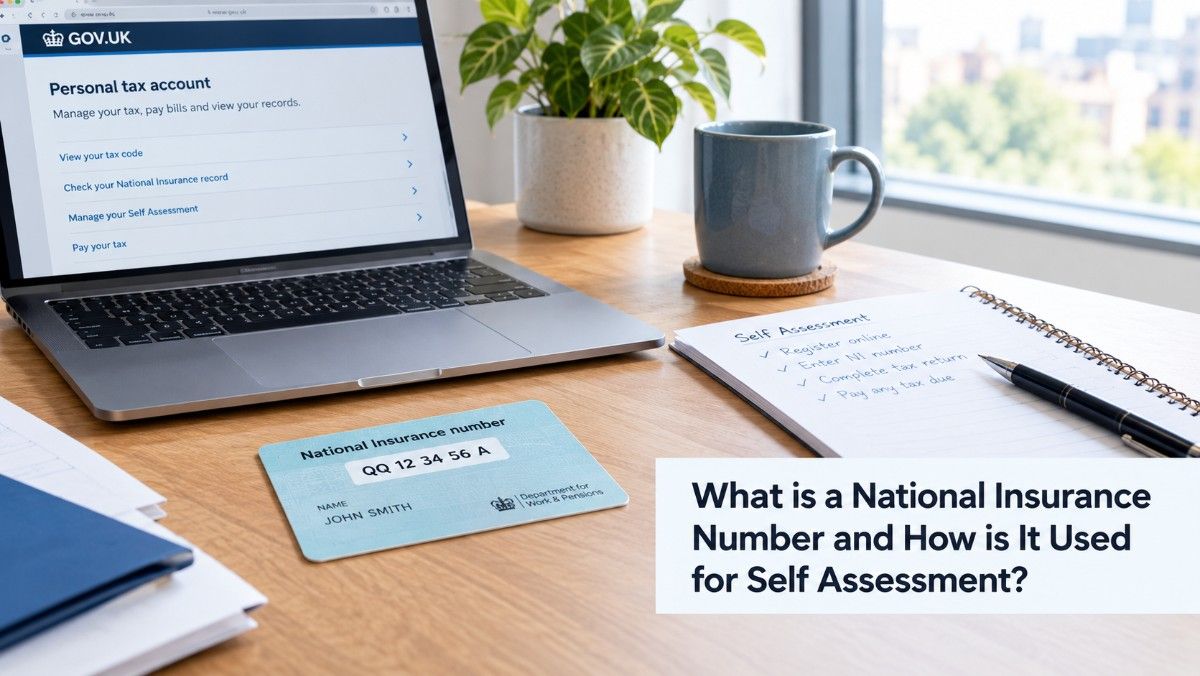
For example: QQ 12 34 56 C.
You should keep your National Insurance Number secure and only provide it when it is genuinely required. HMRC advises against sharing it unnecessarily because personal information can potentially be misused for identity fraud.
Your National Insurance Number helps HMRC maintain an accurate record of your tax and National Insurance history.
It can be relevant when you:
Your National Insurance record can also show contributions and credits and whether there are gaps that could affect your qualifying years for State Pension purposes.
For anyone completing Self Assessment, keeping your National Insurance Number available can make the registration and filing process more straightforward.
Self Assessment is HMRC's system for collecting Income Tax from people whose tax is not fully collected through PAYE. This can include self-employed individuals, people with certain additional income and others who meet HMRC's requirements for submitting a tax return.
When you register for Self Assessment, HMRC may ask for your UK National Insurance Number if you have one. It is one of the details used when setting up your Self Assessment records.
Your National Insurance Number is therefore different from your Unique Taxpayer Reference (UTR).
These two numbers are often confused, but they serve different purposes:
|
National Insurance Number |
UTR |
|
Identifies you for National Insurance and tax records |
Identifies your Self Assessment tax records |
|
Usually remains the same for life |
Issued when you register for Self Assessment |
|
Used across relevant government records |
Mainly associated with Self Assessment |
|
Usually consists of letters and numbers |
Usually a 10-digit number |
Both may be needed when dealing with your tax affairs, so it is useful to keep your records organised.
If you are asking how to find my National Insurance Number, you may not need to contact HMRC immediately. There are several places where you can check.
Your National Insurance Number may appear on:
If you have saved your National Insurance Number to Apple Wallet or Google Wallet, you may also be able to access it there.
If you are searching where can I find my National Insurance Number, your Personal Tax Account is one of the most convenient options.
Once signed in, you can access various tax-related records, including your National Insurance Number. Your Personal Tax Account can also be used to manage other tax matters, view tax information and submit or manage a Self Assessment tax return.
The HMRC app can also provide access to your National Insurance Number.
If you cannot find it online or on your documents, HMRC provides a process for requesting a copy by post. You may need to complete form CA5403, print and sign it, and provide documents to confirm your identity.
If you have never been issued a National Insurance Number, you may need to apply for one, depending on your circumstances.
People who have moved to the UK may already have one if they have previously worked or claimed certain benefits. If you do not have one, you should check the relevant HMRC process rather than creating or guessing a number yourself.
A National Insurance Number should never be invented or substituted with another reference number when completing tax documentation.
Imagine Joe starts working as a self-employed graphic designer. He earns income from several clients and determines that he needs to register for Self Assessment.
During registration, he provides his personal details, including his National Insurance Number. HMRC uses the information to connect his records appropriately.
Later, Joe receives his Self Assessment details and UTR. When completing his tax return, he uses the appropriate information requested by HMRC.
The important point is that Joe's National Insurance Number and UTR are not interchangeable. Each serves a different purpose within his tax affairs.
Because your National Insurance Number is linked to your personal records, you should treat it as confidential information.
Consider the following:
Taking these simple precautions can help reduce mistakes and protect your personal information.
Your National Insurance Number itself does not determine how much Income Tax you owe. Your Self Assessment liability depends on the income, gains, allowances, reliefs and other relevant information reported on your tax return.
For example, a self-employed person may need to consider both Income Tax and National Insurance contributions depending on their circumstances. Your National Insurance record is separate from the calculation of your overall Self Assessment bill.
This is why it is important to provide accurate information and understand which parts of your tax return relate to Income Tax and which relate to National Insurance.
Understanding what is a National Insurance Number and how to find it is an important part of managing your UK tax affairs. Although it is different from your UTR, it can be required when registering for Self Assessment and helps HMRC correctly connect your tax and National Insurance records. . If you are self-employed or responsible for your own tax return, keeping your information accurate is essential.
PHS Associates can help you understand your Self Assessment obligations, organise your tax information and prepare and submit your tax return accurately. Our professional support can give you greater confidence when dealing with HMRC and help you stay on top of your tax responsibilities. Contact book free consultation today to discuss your Self Assessment and accounting requirements.

PHS Associates Acc & Co is led by a skilled team with expertise in Accounting, Taxation, Payroll, Business consultancy, and Company secretarial services.
© Copyright 2026 PHS Associates Acc & Co
Company number - 08670151